
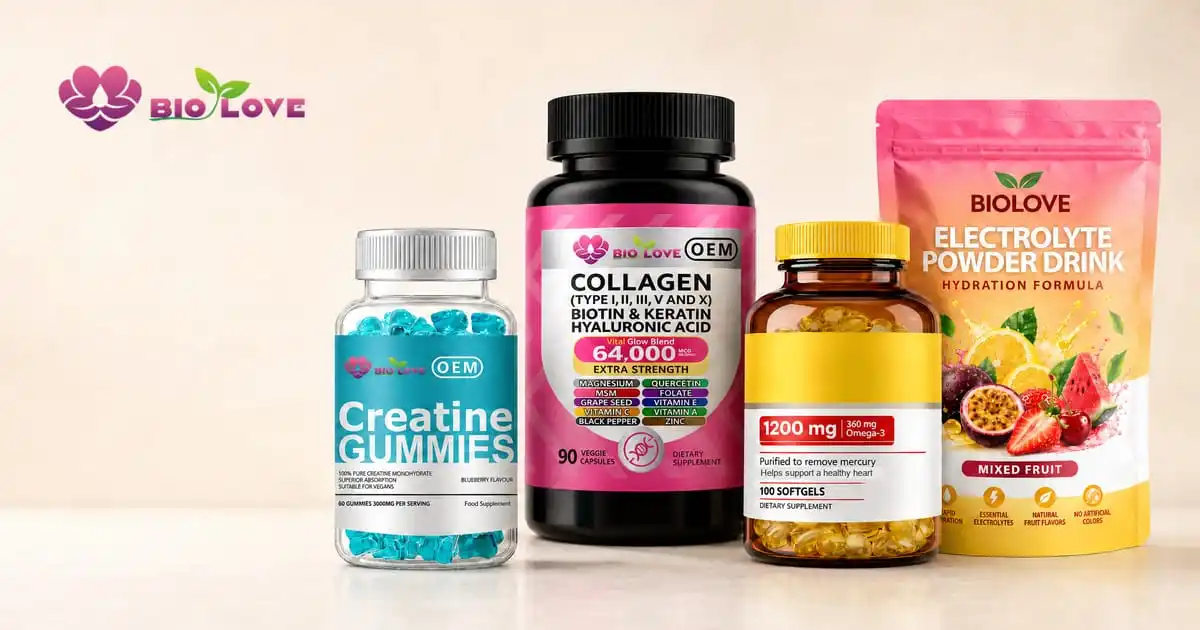
Launching a supplement brand used to require a six-figure budget and years of industry connections. Today, thousands of Amazon sellers, wellness startups, and established distributors source private label supplements from China every month — attracted by mature manufacturing infrastructure, flexible order quantities, and a supply chain that covers nearly every dosage form from gummies to softgels.
But the same market that creates the opportunity also creates the risk. Quality varies dramatically between factories, documentation standards differ, and a bad first supplier can cost you inventory, marketplace listings, and brand trust.
This guide walks through how to source private label supplements from China the professional way: what to verify before you pay a deposit, what MOQs to realistically expect, which documents protect you, and how to get your first shipment through customs without surprises.
Why Global Brands Source Private Label Supplements from China
China’s nutritional supplement manufacturing sector has matured significantly over the past decade. A large share of the world’s raw ingredients — from collagen peptides to botanical extracts — are produced there, which means Chinese contract manufacturers often have shorter lead times and lower ingredient costs than factories that must import the same materials.
For private label buyers specifically, three advantages stand out:
- Full dosage-form coverage. One partner can typically supply capsules, tablets, softgels, powders, drops, and gummies, so you can scale a product line without switching vendors.
- Flexible entry points. Stock formulas with your label (white label) let you test the market quickly, while custom OEM/ODM development lets you differentiate later. If you are still deciding between these models, our OEM vs. ODM guide breaks down the trade-offs.
- Export experience. Established manufacturers already handle COAs, health certificates, and export documentation for the US, EU, and Southeast Asian markets daily.
The caveat: these advantages only materialize if you vet the factory properly. That is what the checklist below is for.
Step-by-Step: How to Source Private Label Supplements from China
Step 1. Define your product before contacting suppliers
Manufacturers can quote accurately only when they know what you want. Before reaching out, decide:
- Dosage form — gummy, capsule, softgel, tablet, powder, or liquid drop
- Formula route — an existing stock formula with your label, or a custom formula (see our custom formula development guide for the full process)
- Target specs — dose per serving, servings per bottle, flavor, and packaging format
- Target market — US, EU, or elsewhere, since labeling rules differ
- Estimated annual volume — even a rough number helps suppliers propose the right MOQ tier
Step 2. Vet the manufacturer with a due-diligence checklist
A credible contract manufacturer should be able to provide all of the following without hesitation:
- [ ] GMP certification for the production facility (and ideally an ISO 22000 or HACCP food-safety management certificate)
- [ ] FDA facility registration number, if you are selling into the United States (registration is required for facilities that manufacture, process, pack, or hold food and dietary supplements for the US market)
- [ ] Business license and export qualifications confirming the entity is legally registered to export
- [ ] Third-party test reports (COA) from an independent lab — not just in-house testing — for heavy metals, microbiology, and label-claim potency
- [ ] Real facility access — live video walkthroughs or an in-person audit invitation
- [ ] Reference clients or verifiable export history to your region
If a supplier cannot produce these documents, treat it as disqualifying regardless of price.
Step 3. Order samples before committing
Request samples of the stock formula you plan to label, or a pilot batch of your custom formula. Evaluate taste, texture, capsule fill consistency, and packaging integrity. For gummies in particular, ask how the product behaves after ocean freight — heat and humidity during a 30-day voyage are a real stability test. Many buyers ship samples to themselves and let them sit for a few weeks before deciding.
Step 4. Understand realistic MOQs
Minimum order quantities in China’s supplement industry generally follow this pattern (actual numbers vary by manufacturer, formula complexity, and dosage form — always confirm in writing):
| Route | Typical MOQ Range | Best For |
|---|---|---|
| Stock formula + your label (white label) | From a few hundred to ~1,000 units | Market testing, Amazon FBA launches |
| Custom formula — capsules / tablets | Often ~5,000 units per SKU | Differentiated products at scale |
| Custom formula — gummies / softgels | Often ~10,000+ units per SKU | Brands with validated demand |
Gummies and softgels carry higher MOQs because production requires dedicated molds, flavor development, and longer line setup. If your budget is limited, a common strategy is to launch with a white-label stock formula at low MOQ, then migrate to a custom formula once the SKU proves itself.
Step 5. Get labeling and compliance right
For the US market, your label must comply with FDA regulations, including an accurate Supplement Facts panel, proper structure/function claim language, and the required disclaimer. Selling on Amazon adds another layer: the marketplace increasingly requests invoices, evidence of GMP-compliant manufacturing, and COAs when gating supplement categories or reviewing listings. Ask your manufacturer to supply documentation packages that satisfy both regulators and marketplaces — this is a standard request for experienced exporters.
Step 6. Insist on quality control at three checkpoints
Professional buyers verify quality at three moments, not one:
- Raw materials — supplier COAs for every ingredient lot before production begins
- In-process — weight variation, moisture, and dissolution checks during the run
- Finished goods — third-party COA on the actual batch you receive, matched to your PO number
Never accept a generic “template COA.” The document must reference your specific batch.
Step 7. Plan logistics and Incoterms
Agree on shipping terms before production starts. In brief: EXW puts all logistics risk on you; FOB means the supplier delivers to the Chinese port and you handle ocean freight and import clearance; DDP means the supplier delivers duty-paid to your door. First-time importers often prefer FOB with their own freight forwarder, or DDP if the manufacturer has reliable US/EU logistics partners. Confirm lead times in writing — production plus freight typically totals 6–10 weeks for ocean shipping.
Red Flags That Should End the Conversation
Walk away if a supplier:
- Quotes dramatically below every other factory — in supplements, rock-bottom pricing usually means under-dosed actives or unlabeled fillers
- Refuses third-party testing or only offers in-house lab results
- Cannot provide a facility video call or audit
- Pressures you for full payment upfront with no sample or contract milestone
- Promises disease-treatment claims or “FDA approved” language — the FDA does not approve dietary supplements, and any manufacturer suggesting otherwise is signaling compliance risk
Start Your Private Label Program with BIOLOVE
BIOLOVE is a supplement OEM/ODM manufacturer in Zhengzhou, China, producing gummies, powders, capsules, softgels, tablets, and drops for brands worldwide — from collagen peptides and creatine gummies to probiotics and keto + ACV formulas.
If you are evaluating suppliers, we invite you to compare us against every item on the checklist above. Browse our private label catalog or request a quote and documentation package — including current facility certifications, sample COAs, and MOQ details for your target dosage form.
Frequently Asked Questions
What is the minimum order quantity for private label supplements from China?
It depends on the route. White-label products using a stock formula can start from a few hundred units at some manufacturers, while fully custom gummies or softgels typically require 5,000–10,000+ units per SKU. Always confirm MOQ in writing before sampling.
Are supplements made in China safe?
Safety depends on the specific facility, not the country. Choose manufacturers with GMP certification, FDA facility registration (for US-bound goods), and independent third-party COAs. Verify documents, request facility access, and test finished batches yourself when possible.
Do I need FDA registration to import private label supplements into the US?
The manufacturing facility must be registered with the FDA, and foreign facilities must designate a US agent. Dietary supplements do not require pre-market FDA approval, but labeling must comply with FDA regulations, including a proper Supplement Facts panel.
How long does it take to launch a private label supplement from China?
White-label projects can ship in as little as 3–5 weeks after label approval. Custom formula development typically takes 8–16 weeks including sampling and testing. Add 4–6 weeks for ocean freight to the US or EU.
Can Amazon sellers source private label supplements from China?
Yes — many Amazon FBA supplement brands manufacture in China. To pass Amazon’s compliance reviews, keep purchase invoices, GMP documentation, batch-specific COAs, and labels that match your listing exactly.

One Response